
Instructions to use HiTZ/mbert-argmining-abstrct-multilingual with libraries, inference providers, notebooks, and local apps. Follow these links to get started.
- Libraries
- Transformers
How to use HiTZ/mbert-argmining-abstrct-multilingual with Transformers:
# Use a pipeline as a high-level helper from transformers import pipeline pipe = pipeline("token-classification", model="HiTZ/mbert-argmining-abstrct-multilingual")# Load model directly from transformers import AutoTokenizer, AutoModelForTokenClassification tokenizer = AutoTokenizer.from_pretrained("HiTZ/mbert-argmining-abstrct-multilingual") model = AutoModelForTokenClassification.from_pretrained("HiTZ/mbert-argmining-abstrct-multilingual") - Notebooks
- Google Colab
- Kaggle
mBERT for multilingual Argument Detection in the Medical Domain
This model is a fine-tuned version of bert-base-multilingual-cased for the argument component detection task on AbstRCT data in English, Spanish, French and Italian (https://huggingface.co/datasets/HiTZ/multilingual-abstrct).
Performance
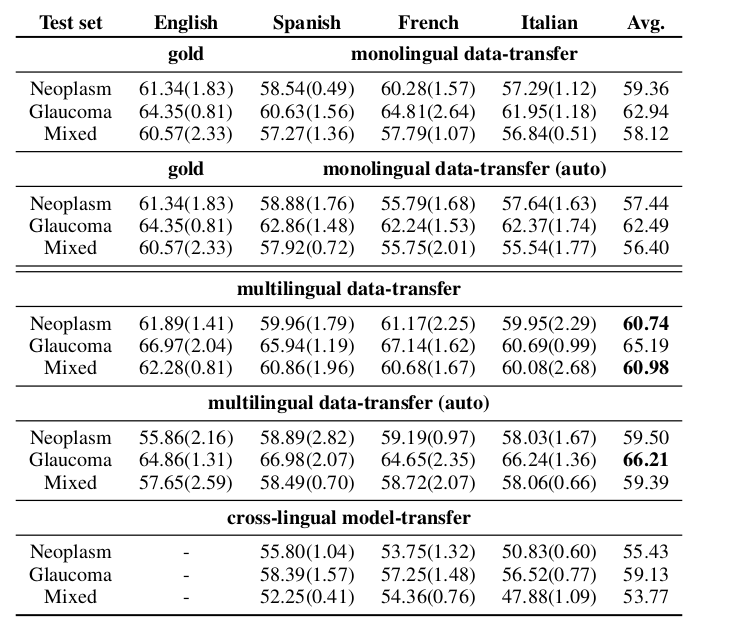
F1-macro scores (at sequence level) and their averages per test set from the argument component detection results of monolingual, monolingual automatically post-processed, multilingual, multilingual automatically post-processed, and crosslingual experiments.
Training hyperparameters
The following hyperparameters were used during training:
- learning_rate: 5e-05
- train_batch_size: 16
- eval_batch_size: 8
- seed: 42
- optimizer: Adam with betas=(0.9,0.999) and epsilon=1e-08
- lr_scheduler_type: linear
- num_epochs: 3.0
Framework versions
- Transformers 4.40.0.dev0
- Pytorch 2.1.2+cu121
- Datasets 2.16.1
- Tokenizers 0.15.2
Contact: Anar Yeginbergen and Rodrigo Agerri HiTZ Center - Ixa, University of the Basque Country UPV/EHU
- Downloads last month
- 5
Model tree for HiTZ/mbert-argmining-abstrct-multilingual
Base model
google-bert/bert-base-multilingual-cased