Instructions to use LoneStriker/OpenCodeInterpreter-DS-6.7B-4.0bpw-h6-exl2 with libraries, inference providers, notebooks, and local apps. Follow these links to get started.
- Libraries
- Transformers
How to use LoneStriker/OpenCodeInterpreter-DS-6.7B-4.0bpw-h6-exl2 with Transformers:
# Use a pipeline as a high-level helper from transformers import pipeline pipe = pipeline("text-generation", model="LoneStriker/OpenCodeInterpreter-DS-6.7B-4.0bpw-h6-exl2") messages = [ {"role": "user", "content": "Who are you?"}, ] pipe(messages)# Load model directly from transformers import AutoTokenizer, AutoModelForCausalLM tokenizer = AutoTokenizer.from_pretrained("LoneStriker/OpenCodeInterpreter-DS-6.7B-4.0bpw-h6-exl2") model = AutoModelForCausalLM.from_pretrained("LoneStriker/OpenCodeInterpreter-DS-6.7B-4.0bpw-h6-exl2") messages = [ {"role": "user", "content": "Who are you?"}, ] inputs = tokenizer.apply_chat_template( messages, add_generation_prompt=True, tokenize=True, return_dict=True, return_tensors="pt", ).to(model.device) outputs = model.generate(**inputs, max_new_tokens=40) print(tokenizer.decode(outputs[0][inputs["input_ids"].shape[-1]:])) - Notebooks
- Google Colab
- Kaggle
- Local Apps
- vLLM
How to use LoneStriker/OpenCodeInterpreter-DS-6.7B-4.0bpw-h6-exl2 with vLLM:
Install from pip and serve model
# Install vLLM from pip: pip install vllm # Start the vLLM server: vllm serve "LoneStriker/OpenCodeInterpreter-DS-6.7B-4.0bpw-h6-exl2" # Call the server using curl (OpenAI-compatible API): curl -X POST "http://localhost:8000/v1/chat/completions" \ -H "Content-Type: application/json" \ --data '{ "model": "LoneStriker/OpenCodeInterpreter-DS-6.7B-4.0bpw-h6-exl2", "messages": [ { "role": "user", "content": "What is the capital of France?" } ] }'Use Docker
docker model run hf.co/LoneStriker/OpenCodeInterpreter-DS-6.7B-4.0bpw-h6-exl2
- SGLang
How to use LoneStriker/OpenCodeInterpreter-DS-6.7B-4.0bpw-h6-exl2 with SGLang:
Install from pip and serve model
# Install SGLang from pip: pip install sglang # Start the SGLang server: python3 -m sglang.launch_server \ --model-path "LoneStriker/OpenCodeInterpreter-DS-6.7B-4.0bpw-h6-exl2" \ --host 0.0.0.0 \ --port 30000 # Call the server using curl (OpenAI-compatible API): curl -X POST "http://localhost:30000/v1/chat/completions" \ -H "Content-Type: application/json" \ --data '{ "model": "LoneStriker/OpenCodeInterpreter-DS-6.7B-4.0bpw-h6-exl2", "messages": [ { "role": "user", "content": "What is the capital of France?" } ] }'Use Docker images
docker run --gpus all \ --shm-size 32g \ -p 30000:30000 \ -v ~/.cache/huggingface:/root/.cache/huggingface \ --env "HF_TOKEN=<secret>" \ --ipc=host \ lmsysorg/sglang:latest \ python3 -m sglang.launch_server \ --model-path "LoneStriker/OpenCodeInterpreter-DS-6.7B-4.0bpw-h6-exl2" \ --host 0.0.0.0 \ --port 30000 # Call the server using curl (OpenAI-compatible API): curl -X POST "http://localhost:30000/v1/chat/completions" \ -H "Content-Type: application/json" \ --data '{ "model": "LoneStriker/OpenCodeInterpreter-DS-6.7B-4.0bpw-h6-exl2", "messages": [ { "role": "user", "content": "What is the capital of France?" } ] }' - Docker Model Runner
How to use LoneStriker/OpenCodeInterpreter-DS-6.7B-4.0bpw-h6-exl2 with Docker Model Runner:
docker model run hf.co/LoneStriker/OpenCodeInterpreter-DS-6.7B-4.0bpw-h6-exl2
# Load model directly
from transformers import AutoTokenizer, AutoModelForCausalLM
tokenizer = AutoTokenizer.from_pretrained("LoneStriker/OpenCodeInterpreter-DS-6.7B-4.0bpw-h6-exl2")
model = AutoModelForCausalLM.from_pretrained("LoneStriker/OpenCodeInterpreter-DS-6.7B-4.0bpw-h6-exl2")
messages = [
{"role": "user", "content": "Who are you?"},
]
inputs = tokenizer.apply_chat_template(
messages,
add_generation_prompt=True,
tokenize=True,
return_dict=True,
return_tensors="pt",
).to(model.device)
outputs = model.generate(**inputs, max_new_tokens=40)
print(tokenizer.decode(outputs[0][inputs["input_ids"].shape[-1]:]))OpenCodeInterpreter: Integrating Code Generation with Execution and Refinement
Introduction
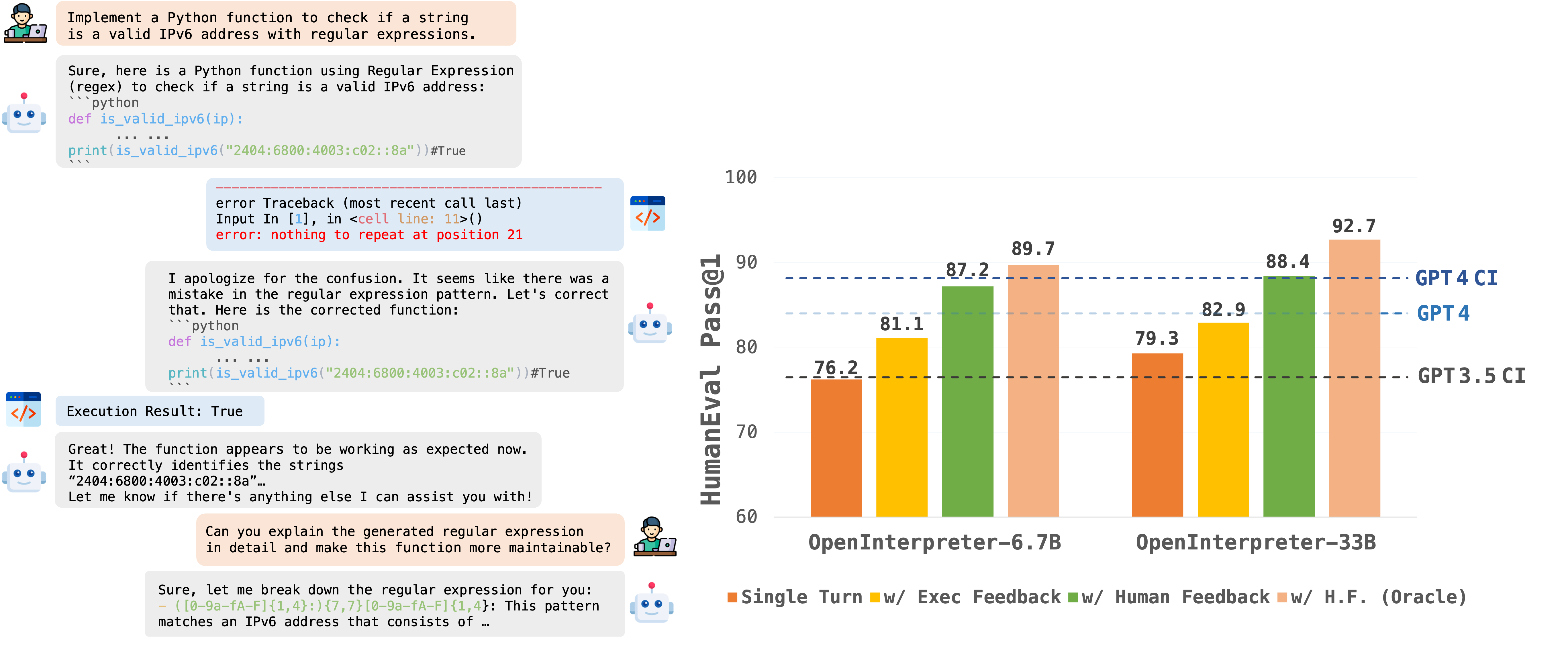
OpenCodeInterpreter is a family of open-source code generation systems designed to bridge the gap between large language models and advanced proprietary systems like the GPT-4 Code Interpreter. It significantly advances code generation capabilities by integrating execution and iterative refinement functionalities.
For further information and related work, refer to our paper: "OpenCodeInterpreter: A System for Enhanced Code Generation and Execution" available on arXiv.
Model Usage
Inference
import torch
from transformers import AutoTokenizer, AutoModelForCausalLM
model_path="OpenCodeInterpreter-DS-6.7B"
tokenizer = AutoTokenizer.from_pretrained(model_path)
model = AutoModelForCausalLM.from_pretrained(
model_path,
torch_dtype=torch.bfloat16,
device_map="auto",
)
model.eval()
prompt = "Write a function to find the shared elements from the given two lists."
inputs = tokenizer.apply_chat_template(
[{'role': 'user', 'content': prompt }],
return_tensors="pt"
).to(model.device)
outputs = model.generate(
inputs,
max_new_tokens=1024,
do_sample=False,
pad_token_id=tokenizer.eos_token_id,
eos_token_id=tokenizer.eos_token_id,
)
print(tokenizer.decode(outputs[0][len(inputs[0]):], skip_special_tokens=True))
Contact
If you have any inquiries, please feel free to raise an issue or reach out to us via email at: xiangyue.work@gmail.com, zhengtianyu0428@gmail.com. We're here to assist you!"
- Downloads last month
- 5
# Use a pipeline as a high-level helper from transformers import pipeline pipe = pipeline("text-generation", model="LoneStriker/OpenCodeInterpreter-DS-6.7B-4.0bpw-h6-exl2") messages = [ {"role": "user", "content": "Who are you?"}, ] pipe(messages)